Shower screens in toughened glass, made to size
A made-to-size shower screen is produced in toughened glass, because ordinary glass would be dangerous in a bathroom. The size, the holes for the hardware and any cut-outs have to be in the brief before toughening, because a finished pane cannot be altered.
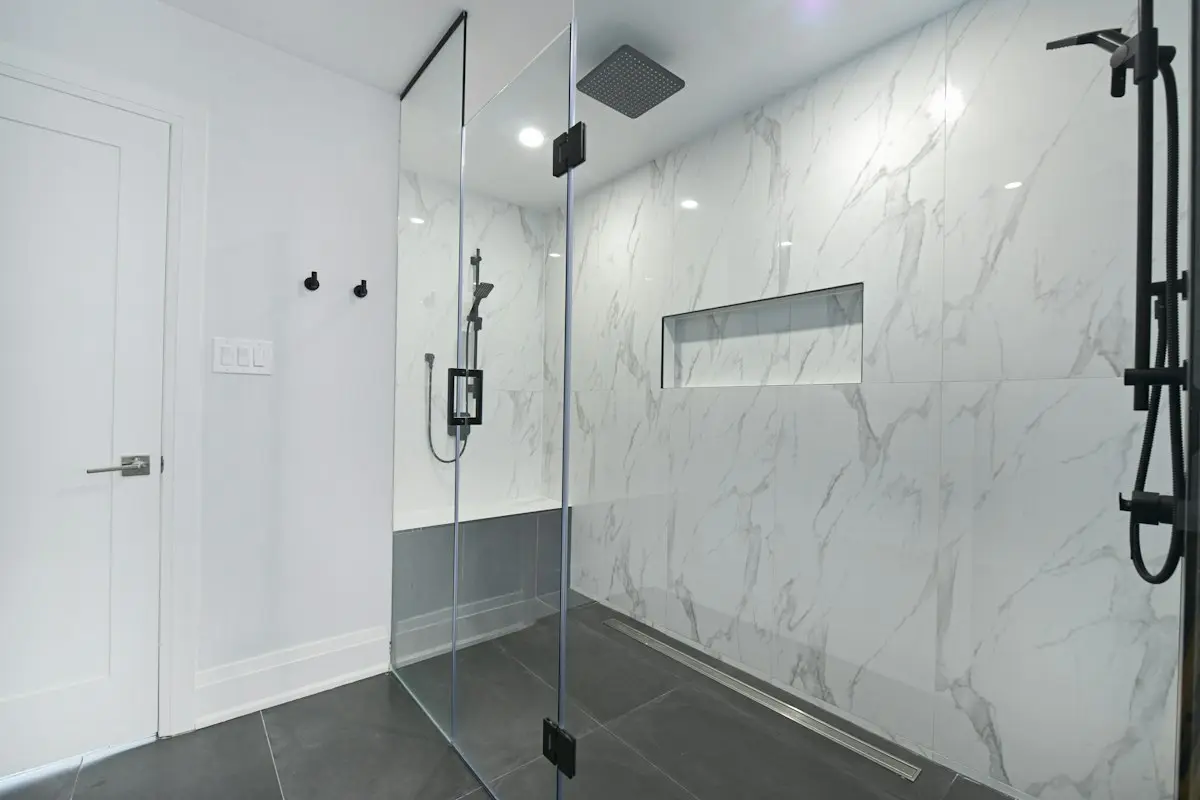
Three basic solutions
- Walk-in panel. A fixed pane with no door, often with a single brace to the ceiling or the wall. The easiest to maintain, because it has the least hardware and no seals in a moving part.
- Hinged door. The classic for smaller bathrooms with enough room in front of the shower. You have to allow for the space the door swings into.
- Sliding door. For places with no room to open sideways. More hardware and more places where limescale shows up over time.
Why screens are made to size
Off-the-shelf enclosures assume a square bathroom and straight walls. In reality the wall is slightly bowed, the tray is not perfectly level and the tiling has an irregularity at the edges. A made-to-size screen is surveyed on site, and these deviations are handled either by an adjustable wall profile or by the shape of the pane itself.
The second common reason is an awkward space: a sloping ceiling in a loft, a column, a sill that projects into the shower, or an alcove that no standard enclosure fits.
What has to be settled before production
- the dimensions and the height of the pane,
- the way it opens and which side the hinges are on,
- the position of the holes for the hinges, the handle and the brace,
- cut-outs around a sill, a column or a tap,
- whether you want clear, obscured or tinted glass,
- whether the glass should have a protective surface treatment.
Once toughened, the pane cannot be drilled or cut. A change at that stage means a new pane.
Hardware and profiles
The hardware holds the pane, keeps it sealed, and is the most common place where a problem turns up years later. In the enquiry it is worth saying whether you want polished stainless, matt black, or as few visible components as possible. For sliding systems it helps to know whether the track is only at the top or whether there is a bottom guide too. A bottom guide is harder to clean.
Protective treatment and care
A protective treatment can be applied to toughened glass to reduce limescale build-up. It is not a surface that never needs cleaning, only one that cleans more easily and keeps looking good for longer. Durability varies between products and it is usually renewed after a few years.
The single most useful habit is a squeegee after showering. Aggressive cleaners and abrasive pads damage both the treatment and the glass itself.
What to put in the enquiry
- the dimensions of the shower area and the ceiling height,
- whether there is a tray or the floor is level with the room,
- a photo of the space including the walls,
- whether you are also dealing with a mirror or a splashback, so one survey can cover it.
Frequently asked questions
Does a shower screen have to be toughened glass?
Toughened glass is the standard for shower screens, because once broken it shatters into small blunt fragments rather than sharp shards. What exactly is required in a particular position normally follows from the standards, and the glazing firm checks it.
Will a made-to-size screen fit a sloping loft ceiling?
Yes, and that is one of the main reasons screens are made to size. The shape of the pane is cut from a template taken on site.
Can a handle or a towel rail be added to a finished screen?
Toughened glass is not drilled afterwards. Clamp-on fittings that grip over the edge of the pane are used instead, or the fitting is planned in from the start.
Send us the glass sizes
An e-mail address is enough. Tell us what broke or what you need made, and add the dimensions even if they are only approximate.
- Send the shower dimensions and the ceiling height.
- Say whether you want a walk-in panel, a hinged or a sliding door.
- A photo of the bathroom helps judge how uneven the walls are.